Vinyl-Wrapped Kitchens: Why They Peel and What Actually Fixes It (2026)
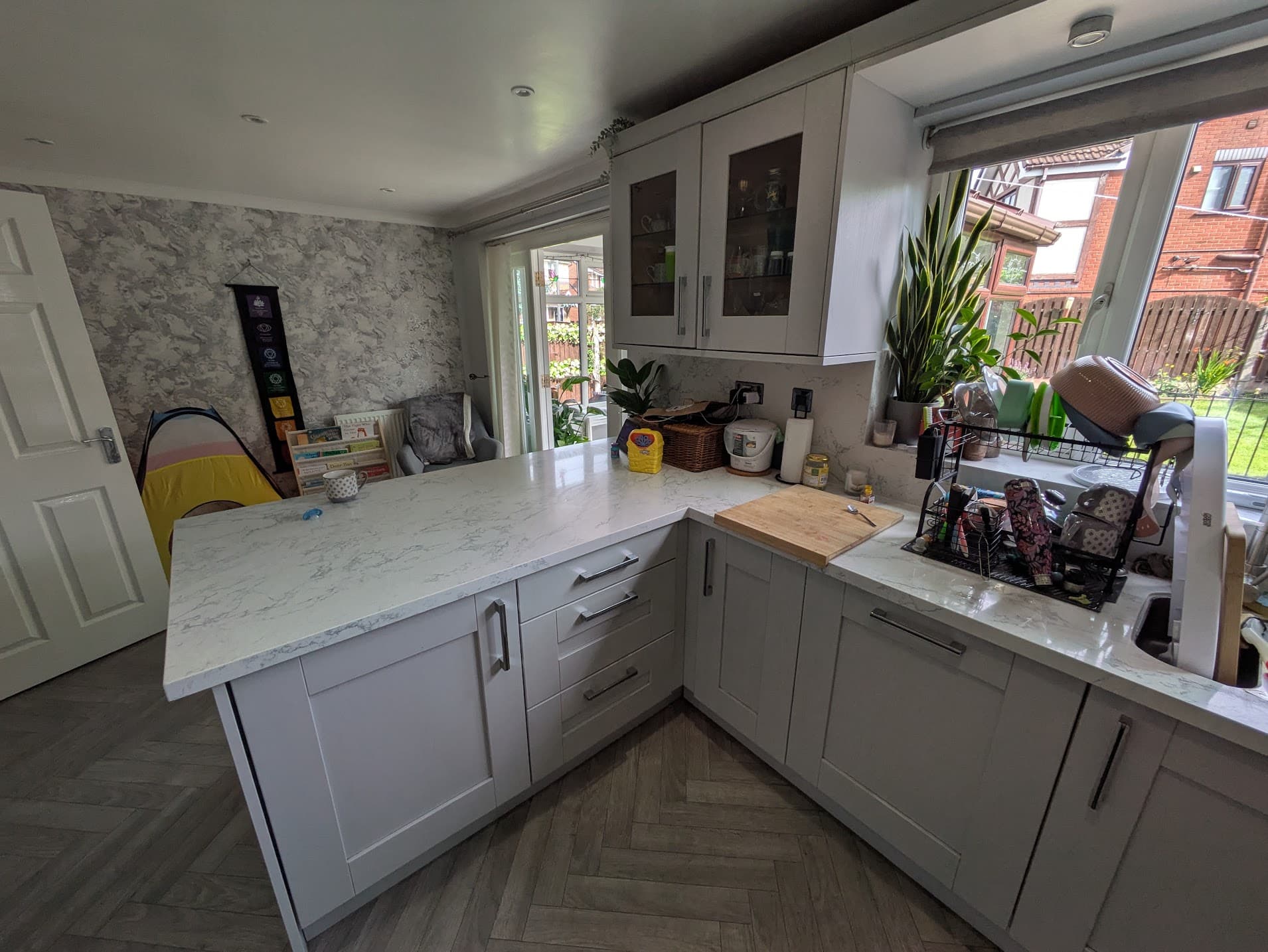
We see four or five of these every week. Customer rings, slightly embarrassed, slightly annoyed. “I think it's a Howdens kitchen, about six years old, but the doors are starting to peel near the dishwasher and the bottom of the wall unit by the kettle.” Then a photo arrives — a strip of laminate hanging away from the door, raw MDF showing underneath, the start of what's about to spread to every door in the kitchen if left alone.
This is the vinyl-wrap problem. It affects somewhere around 60% of mid-market UK kitchens fitted between 2010 and 2022. It's not a defect. It's not bad luck. It's a predictable failure mode of a material that was never meant to last forever. The good news is it's fully fixable. The bad news is most “fixes” — including those quoted by other respray companies — actively make the problem worse.
What “vinyl-wrapped” actually means
Walk into a Howdens, Wickes, B&Q or Magnet showroom and look at the kitchen doors. Most of what you see in the mid-price ranges isn't painted wood or even painted MDF — it's vinyl-wrapped.
The construction is essentially this: a moisture-resistant MDF (medium-density fibreboard) core, machined into a door shape with a routed profile, then covered in a thin PVC film (the “vinyl”) which is heat-pressed onto the MDF using a vacuum membrane and an adhesive. The film can be made to look like almost anything — gloss white, oak grain, painted shaker, you name it. From across the kitchen on day one, you genuinely cannot tell it isn't real paint.
The advantages are real. Vinyl-wrapped doors are cheaper to make than painted doors, easier to clean than wood, available in any colour, and consistent in finish — every door in the kitchen looks identical because they're all wrapped from the same roll of film.
The disadvantage is also real. The bond between PVC and MDF is mechanical and adhesive — not chemical. And mechanical-adhesive bonds, especially ones exposed to heat and moisture cycling, have a finite lifespan. The doors look great for the first 3–4 years. Then they don't.
Why it peels — the chemistry
Three things conspire to break the vinyl-MDF bond:
1. Heat. Vinyl is a thermoplastic — it softens at relatively low temperatures (vinyl-wrap is heat-applied in the first place, around 80°C). Daily exposure to steam from kettles, hobs, dishwashers and ovens cycles the vinyl through repeated heat softening and re-cooling. Each cycle very slightly weakens the adhesive bond. Over years, this fatigue accumulates.
2. Moisture ingress at edges. The vinyl wraps around the door but is cut at the back. The back edge — and the holes drilled for hinges and handles — are seal points. Over time, moisture from kitchen humidity penetrates these edge points and reaches the adhesive layer. Where moisture meets adhesive, the bond fails.
3. MDF swelling. When moisture reaches the MDF core, the MDF swells microscopically. The vinyl on the surface doesn't swell. This creates shear stress at the bond line. Eventually the bond gives way and the vinyl lifts.
The failure pattern is therefore entirely predictable. It always starts at:
- The bottom edge of doors above dishwashers (most concentrated steam exposure)
- Doors directly under or above kettles
- Doors immediately beside ovens
- The bottom of base unit doors under sinks (moisture from below)
- Any door that's had a leak nearby
If your peeling is happening anywhere else first, something unusual is going on — usually a manufacturing defect or installation damage.
How to identify whether your kitchen is vinyl-wrapped
Most homeowners aren't sure whether their kitchen is vinyl-wrapped, painted, foiled, melamine, or solid wood. Six quick tests:
1. Check the door edges. Look at where the front face meets the back face. If you can see a thin seam where the surface wraps around — that's vinyl. Painted and solid wood doors don't have this seam.
2. Open a door and look at the back. Vinyl-wrapped doors have a different finish on the back — usually a plain, slightly textured laminate that doesn't match the front. Painted doors are typically painted on both sides.
3. Look for hinge cup holes. On vinyl-wrapped doors, the hinge cup holes show raw MDF inside — the vinyl wraps the front and edges but stops at the hole. Painted doors are painted inside the hinge holes too.
4. Press a fingernail firmly into the surface (in a hidden spot, e.g. the inside top edge). Vinyl gives slightly under pressure and can be scored with a fingernail. Properly painted MDF doesn't.
5. Look for orange peel texture under raking light. Vinyl, when applied over a profiled door, sometimes shows a slight “orange peel” texture from the membrane pressing process. Visible in side-on light.
6. Check the brand. If you have any of these from the relevant era, you're almost certainly vinyl-wrapped: Howdens (most ranges 2010–2022), Magnet Trade ranges, B&Q standard ranges, Wickes Lifestyle and Modern ranges, Wren standard ranges, Symphony standard, Sigma 3 budget ranges. We list the most common ones below.
If you're still not sure, photograph a door edge and send it to us — we can tell from a clear photo.
The fixes that don't work (and why)
This is the most important section of this guide. If you're researching what to do about a peeling vinyl kitchen, these are the four “solutions” you'll be offered, three of which are wrong.
Wrong fix 1: Glue the vinyl back down
Tempting because it looks simple. Quick squirt of contact adhesive under the peeling section, press it back, wait. Doesn't work — and here's why. The vinyl has lifted because the original adhesive has failed across a wide area, not just at the visible peel point. Re-gluing the visible bit re-attaches a 2cm section, but the adhesive failure underneath is propagating across the door. Within 3–6 months, the vinyl peels back up next to your repair. The repair itself often distorts the visible surface — adhesive lumps, mismatched colour where dust got trapped, the vinyl no longer lying flat. Don't.
Wrong fix 2: Paint directly over the existing vinyl
This is the fix offered by most painters and decorators. Sand the doors lightly, prime, paint with a “kitchen-safe” paint, done. It looks fine for 6–12 months. Then the vinyl underneath keeps lifting, and now your paint lifts with it. Worse — because paint hides the early warning signs of vinyl movement, by the time you notice the failure, it's everywhere. We see this every month from customers whose previous decorator told them it would be fine.
Wrong fix 3: Vinyl-wrap over the existing vinyl-wrap
A specialist trade — applying new vinyl film over old. Done well it can look acceptable for 2–3 years. The fundamental problem is that you're now stacking adhesive failures: the old adhesive is failing, the new film has its own adhesive that's bonded to the failing old layer. When the underlying vinyl moves, the new vinyl moves with it. You're buying time, not solving the problem. And you'll need to do it again sooner than a proper respray.
Wrong fix 4: Replace the doors only
Sometimes pitched as a “middle-ground” option. Buy new doors from the original supplier (or matching aftermarket), keep the carcasses. This actually works — but is much more expensive than respraying. Replacement doors typically cost £180–£400 per door, so a 22-door kitchen lands at £4,000–£8,800 just for doors, before installation. A Premium respray giving the same visual result is £1,650–£3,500.
The right call is workshop respraying with full vinyl removal. Which leads us to…
The only proper fix — and how it's done
A properly done vinyl-wrapped kitchen respray is essentially turning a vinyl-wrapped kitchen into a painted kitchen. It's not painting over the vinyl. It's removing the vinyl and starting from the MDF underneath.
Here's the actual process we use on every vinyl-wrapped Premium respray:
- Doors removed and labelled. Every door numbered, photographed in position, hinges and hardware bagged with their door. Carcasses stay in your kitchen.
- Doors transported to the Denton workshop. This is non-negotiable for vinyl-wrapped kitchens. In-situ work cannot replicate workshop conditions.
- Vinyl removal. Each door has its vinyl film fully removed. Depending on the age and adhesive type, this is done with a combination of heat (controlled heat gun softens the adhesive) and mechanical peeling. The film comes off in strips. The adhesive residue left on the MDF is then chemically removed with appropriate solvents. This process takes 30–60 minutes per door and is the labour cost that makes vinyl-wrap removal more expensive than a standard respray.
- MDF assessment. Once the vinyl is off, we see the bare MDF for the first time. We assess each door for water damage, swelling, or routing damage. Doors that are structurally compromised get flagged for replacement — we don't try to spray over damaged MDF, it always shows.
- MDF sealing. Raw MDF is porous — it absorbs paint inconsistently. Without proper sealing, the surface texture of the MDF telegraphs through the paint and the finish looks uneven. We apply an MDF-specific sealer and sand back to a smooth surface. This step is the one most cheap operators skip.
- Sanding to fine grit. Progressive sanding from 240 grit to 320 grit, creating a perfectly uniform, key-receptive surface across every face.
- Base coat (primer). Industrial 2K primer applied with proper HVLP equipment. Sanded flat between coats.
- Top coats. 2K polyurethane in chosen colour, 2–3 coats with light sanding between each. Doors are sprayed flat on horizontal racks under workshop lighting.
- Lacquer or self-lacquering top coat. Final protective layer. For high-traffic kitchens we use additional clear protective lacquer.
- Cure time. Doors remain in the workshop for 5–10 days. Full chemical cure of 2K paint takes 7 days minimum.
- Refitting. Doors transported back, hardware refitted, every door checked for alignment and gap. Customer walk-around for sign-off.
This process is significantly more involved than spraying a kitchen that's already painted — which is why Premium pricing exists. It's reflective of actual work done.
The carcasses (the boxes) get sprayed separately, in-situ at your home, on day 1. They're not vinyl-wrapped in most kitchens — they're usually melamine or painted MDF — so they can be sprayed in place without the workshop process. They cure while the doors are at the workshop.
Common vinyl-wrapped brands
The most frequent vinyl-wrapped kitchens we work on, with notes on each:
Howdens — The majority of Howdens kitchens in the £4,000–£8,000 cabinetry range are vinyl-wrapped (Greenwich, Greenwich Gloss, Burford, Lamona ranges and similar). The vinyl quality is reasonable but failure at year 4–6 is common. Excellent candidates for respraying — the MDF underneath is usually sound.
Magnet Trade — Their lower and mid-tier ranges are vinyl-wrapped. Failure pattern similar to Howdens.
B&Q (mostly Cooke & Lewis) — Most ranges are vinyl-wrapped. MDF quality varies — some 2012–2016 ranges have softer MDF that needs careful assessment.
Wickes Lifestyle and Modern ranges — Vinyl-wrapped. Generally good MDF substrate, very respray-friendly.
Wren standard ranges — Vinyl-wrapped at the budget end; some mid-range options are foiled (a different but similar process) which we also strip and respray. Wren's “premium” ranges and above are typically painted.
Symphony — Their standard ranges are vinyl-wrapped or foiled.
Sigma 3 budget ranges — Vinyl-wrapped.
Benchmarx — Mostly vinyl-wrapped at the standard tier.
Moores — A mix; older ones often vinyl-wrapped.
If your kitchen is any of these and over 4 years old, peeling is likely imminent if it hasn't started already. Catching it early — before it becomes a “the whole kitchen is falling apart” panic — saves money and makes the eventual respray easier.
Cost and timeline of a proper fix
Real numbers from recent vinyl-wrapped kitchen respray jobs:
| Job | Door count | Vinyl condition | Final price | Workshop time |
|---|---|---|---|---|
| Howdens kitchen, Didsbury | 22 doors | 2 doors actively peeling, rest intact | £2,150 | 7 days |
| Magnet kitchen, Bolton | 28 doors | 4 doors peeling, several with edge lift | £2,450 | 8 days |
| B&Q kitchen, Sale | 16 doors | 1 door peeling, others showing edge lift | £1,850 | 7 days |
| Wren kitchen, Wilmslow | 32 doors | Extensive peeling on 6 doors | £2,950 | 10 days |
| Howdens kitchen, Salford | 24 doors | All doors with minor edge lift | £2,300 | 8 days |
A typical vinyl-wrapped kitchen respray lands at £1,650–£3,000 depending on door count and how much vinyl needs stripping. The full project timeline is:
- Day 1: Doors removed, carcasses sprayed in-situ. ~6–7 hours on site.
- Days 2–8 (approx): Doors at workshop being processed.
- Day 9 or 10: Doors returned and refitted. ~3–4 hours on site.
Your kitchen is useable throughout the process — open carcasses, but functioning. Most clients say the open week was less disruptive than they expected.
Frequently asked questions
Is it worth respraying a vinyl-wrapped kitchen or should I just replace?
Almost always worth respraying. The MDF underneath the vinyl is the actual structural part of the door — the vinyl is essentially a decorative skin. Once you've removed the skin and properly prepared and resprayed the underlying MDF, you have a door that is functionally a painted MDF door, with the same longevity as any decent painted kitchen. Replacement only makes sense if the MDF itself is damaged.
How do I know if my MDF is damaged underneath?
You can't tell until the vinyl comes off. We assess each door once stripped. Common signs of MDF damage: visible swelling at the bottom edge of base unit doors (water damage), softening or crumbling around hinge cup holes (over-stressed hinge points), routing damage from previous handle changes. We typically find 0–2 damaged doors per kitchen, which we flag for replacement before spraying. Replacement doors can be made to match — added to the project at trade cost.
Will I see the vinyl edge after respraying?
No. The vinyl is fully removed, the edge is properly sealed, sanded flat, and painted. The finished door has no visible trace of the previous vinyl. You can't tell from any angle that the kitchen was ever vinyl-wrapped.
Can the door bottoms (where the worst damage usually is) be properly fixed?
Yes, in 95% of cases. Even doors with significant bottom-edge vinyl lift can usually have the underlying MDF cleaned up, sealed, and resprayed cleanly. The exception is doors where moisture has caused the MDF itself to swell, crumble or delaminate — those need replacement.
My vinyl is only just starting to lift. Should I act now or wait?
Act now. Vinyl failure is progressive. Once it starts, it spreads. Acting at year 4 — when only a couple of doors are showing edges — gives you a cheaper, faster respray with no door replacements needed. Waiting until year 7 — when half the kitchen is peeling — often means several doors are too far gone and need replacing. Same problem, different cost.
How long does the new finish last after vinyl removal?
Same as a normal Premium respray: 10+ years. The MDF substrate, properly sealed and painted with 2K, doesn't have the chemistry problems that caused the vinyl to fail. It's a fundamentally more durable construction.
Can you spray over vinyl without removing it?
We won't, because we know it fails within 12–18 months. Some companies will, especially at the cheaper end. Avoid. The shortcut creates a much worse problem than the one you started with.
How much extra is it compared to a non-vinyl kitchen?
Vinyl-wrapped respraying typically costs £300–£700 more than a comparable painted kitchen respray, reflecting the additional 4–8 hours of labour for vinyl removal and MDF sealing across the kitchen. Still vastly cheaper than replacement.
What if only one or two doors are peeling? Can you just respray those?
Technically yes, but we usually recommend against it for vinyl-wrapped kitchens. The colour match between a sprayed door and an original vinyl-wrapped door is never perfect — and as the rest of the kitchen ages, the colour mismatch becomes more visible. Better to do the whole kitchen at once, achieving a uniform finish that ages uniformly.
Do you handle this kind of job often?
Roughly 60% of the kitchens we respray are vinyl-wrapped. It's the most common single category. We have the workshop process, the equipment and the materials specifically optimised for this. If you have a vinyl-wrapped kitchen with peeling doors, you're not an unusual case — you're our typical customer.
Ready for a free quote?
Take our 30-second quiz at revitalizeresprays.co.uk/quote — upload a few photos of your kitchen and we'll come back to you within 24 hours with a fixed price.
Or call Bryan directly on 07384 574225 — straight through to the workshop, no call centre, no chasing.
Revitalize Resprays — Unit 1a, 88-90 Wilton Street, Denton, Manchester M34 3NH. 25+ years wood-finishing experience, 137 five-star Google reviews, as featured in The Times.
Related reading

Bryan Grime
Founder, Revitalize Resprays
More from the blog
How Much Does a Kitchen Respray Cost in 2026? (Real UK Prices, No Guesswork)
Kitchen respray costs in the UK: £999–£3,500 in 2026. Full breakdown by size, finish, and condition from a Manchester sprayer with 25+ years on the tools.
Kitchen ResprayingKitchen Respray vs New Kitchen: The Honest £10,000 Comparison (2026)
Should you respray or replace your kitchen? Real costs, real timelines, real disruption — a Manchester sprayer's honest breakdown after 25+ years on both sides.
Kitchen ResprayingHow Long Does a Sprayed Kitchen Finish Actually Last? (Real Data, 2026)
Sprayed kitchen finishes last 5–7 years (Standard) or 10+ years (Premium). Real data from 25+ years of resprayed kitchens, what makes them fail, and how to maximise lifespan.